

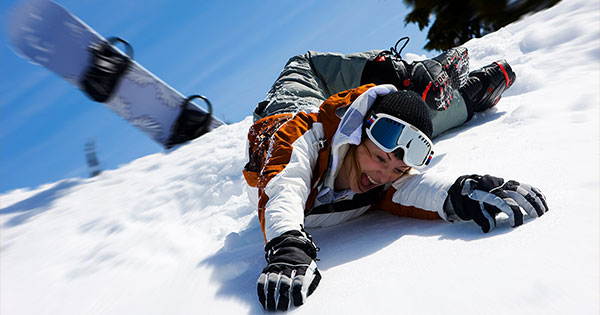
You took a hard fall on the mountain. At first, you thought your shoulder was simply bruised. But now you're struggling to put on your jacket, reach overhead or even lift your arm away from your body.
While soreness is common following a skiing or snowboarding fall, significant shoulder weakness or loss of function should not be ignored.
A traumatic shoulder injury can damage the tendons, ligaments, labrum or bones that allow your shoulder to move and function normally.
What Are the Most Common Shoulder Injuries From Skiing and Snowboarding?Rotator Cuff Tears
The rotator cuff is a group of four muscles and their tendons that help stabilize the shoulder and allow you to lift and rotate your arm.
A fall onto an outstretched arm or a direct impact can result in an acute rotator cuff tear.
Symptoms may include:
- Difficulty actively lifting your arm
- Sudden weakness following a fall
- Pain when reaching overhead
- Pain when sleeping on the affected shoulder
- Difficulty getting dressed or performing everyday activities
Traumatic rotator cuff tears are particularly important to recognize because certain tears may benefit from timely surgical treatment.
Shoulder Labral Tears
The labrum is a ring of cartilage that surrounds the shoulder socket and contributes to stability.
A fall, sudden pulling injury or shoulder dislocation can damage the labrum.
Symptoms may include deep shoulder pain, clicking, catching, instability or discomfort when reaching overhead.
Shoulder Dislocations
A shoulder dislocation occurs when the ball of the shoulder joint moves out of its socket.
Sometimes the shoulder returns to its normal position spontaneously. Even when this happens, damage to the labrum, ligaments, bone or rotator cuff may have occurred.
A shoulder that remains dislocated requires emergency medical attention. Do not attempt to relocate it yourself.
AC Joint Injuries
A direct fall onto the outside of the shoulder can injure the acromioclavicular joint, commonly referred to as the AC joint.
These injuries may cause pain at the top of the shoulder, swelling, a visible bump and discomfort when reaching across your body.
Fractures
Falls while skiing or snowboarding can also cause fractures of the collarbone, upper arm or shoulder blade. X-rays are often necessary to evaluate these injuries.
Is My Shoulder Just Bruised, or Did I Tear Something?
It can be difficult to distinguish a bruise or muscle strain from a more significant injury without a physical examination.
However, the following symptoms should prompt timely evaluation:
- Inability to actively lift your arm
- Significant weakness compared with your uninjured shoulder
- Persistent pain at night
- A sensation that your shoulder is unstable
- Significant swelling or bruising
- Pain that interferes with normal daily activities
- Symptoms that are not improving
Pain intensity alone does not always reflect the severity of an injury. Some patients with significant rotator cuff tears experience relatively modest pain but substantial weakness.
Why Is Early Evaluation Important for a Traumatic Rotator Cuff Tear?
Following a rotator cuff tear, the injured tendon may retract away from its normal attachment to the bone. Over time, some tears may also be associated with muscle atrophy and fatty changes.
These factors can influence treatment options and the ability to repair the tendon.
Not every rotator cuff tear requires surgery. However, identifying a traumatic tear early allows you and your orthopedic surgeon to discuss the most appropriate treatment strategy without unnecessary delays.
Do I Need an MRI of My Shoulder?
X-rays are often obtained following a traumatic shoulder injury to evaluate for fractures and alignment abnormalities.
If your examination suggests a rotator cuff tear, labral injury or another soft-tissue injury, an MRI may be recommended.
You do not need to arrange an MRI before contacting our office. Our clinical team can help coordinate the appropriate diagnostic imaging.
If you already have an MRI, you may request a consultation with Dr. Logan.
When Should I Seek Emergency Care?
Seek emergency evaluation if your shoulder appears dislocated or significantly deformed, you suspect a major fracture, your pain is severe or rapidly worsening, or you experience numbness, loss of sensation or changes in circulation in your arm or hand.
Specialized Shoulder Injury Care in Denver
Dr. Catherine Logan is an orthopedic sports medicine surgeon and team physician for US Ski & Snowboard, specializing in traumatic shoulder injuries, arthroscopic rotator cuff repair, labral repair and shoulder stabilization.
Her practice also treats complex, large, retracted and previously repaired rotator cuff tears.
At the Joint Preservation Center, we develop individualized treatment plans that prioritize restoring shoulder function and helping patients return to their active Colorado lifestyles.
Don't let a fall on the mountain become a long-term shoulder problem.
If you're experiencing shoulder weakness, pain or difficulty lifting your arm following a skiing or snowboarding injury, contact our Denver office to schedule an evaluation.
Schedule A Shoulder Injury Evaluation.
Already Have An MRI? Request A Consultation.


